29 Apr 2013
The liquid helium coolant that enabled instruments on board the Herschel space observatory to collect extraordinary images and spectra has finally run out. Launched in 2009, the ESA mission collected unprecedented data of the cool as well as of the distant Universe. Herschel's observations have exceeded expectations, enabling scientists to learn more about how stars form, about the rates of star formation in galaxies across the cosmos, and about the origin and presence of water in different celestial bodies. While observations have come to an end and the spacecraft is to be propelled to a stable parking orbit around the Sun, where it will remain indefinitely, the science mission will continue for several years with many discoveries still to be made in the treasure trove of images and spectra collected by the observatory.
Herschel cooling system and build up. Credit: ESA/AOES Medialab (Click here for further details about this animation.)
|
Observations on ESA's Herschel space observatory ceased on 29 April 2013, as the supply of liquid helium coolant on board the spacecraft had completely evaporated. The most powerful infrared telescope ever flown in space, Herschel operated at far-infrared and sub-millimetre wavelengths, being sensitive to a wide range of low temperatures from a few hundred to less than ten degrees above absolute zero.
"To observe very cold regions with high sensitivity, Herschel's instruments needed to be at even lower temperatures – only a few degrees above absolute zero," explains Thomas Passvogel, Head of the Projects Department in ESA's Directorate of Science and Robotic Exploration, and former Herschel and Planck Programme Manager. "This was achieved through the use of 2300 litres of superfluid helium, which granted us over three and a half years of observations of the cool and distant Universe," he adds.
"Herschel's observations have revealed the cosmos in unprecedented detail at these wavelengths," comments Göran Pilbratt, Herschel Project Scientist at ESA. "We have very exciting results from the observatory's first few years and we are looking forward to many more exciting discoveries," he adds.
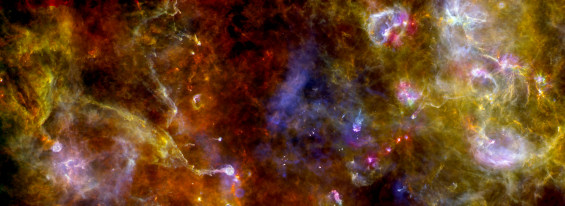 |
The Cygnus X star-forming complex. Credit: ESA/PACS/SPIRE/Martin Hennemann & Frédérique Motte, Laboratoire AIM Paris-Saclay, CEA/Irfu - CNRS/INSU - Univ. Paris Diderot, France
|
Spanning 12 billion years of star formation in the Universe
Herschel's chief goal is the study of star formation throughout the cosmos, so astronomers have used it to survey thousands of galaxies across a wide span of the Universe's history. These data revealed that galaxies in the first few billion years of cosmic history contributed many more stars than had been previously estimated using observations at shorter or longer wavelengths.
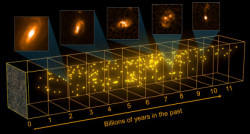 |
A new census of starburst galaxies across the Universe.
Credit: ESA - C. Carreau/C. Casey (University of Hawai'i); COSMOS field: ESA/Herschel/SPIRE/HerMES Key Programme; Hubble images: NASA, ESA |
"Herschel has allowed us to see for the first time a huge population of intensively star-forming galaxies that make up about half of the entire star formation budget of the Universe," comments Matt Griffin from Cardiff University, UK, who is the Principal Investigator of the Spectral and Photometric Imaging Receiver (SPIRE) on board Herschel. "This highlights the importance of looking at the distant Universe in the spectral range covered by Herschel. Stars form in clouds of gas and dust, and most of the energy released by forming stars is absorbed by the dust grains, causing them to warm up. We can detect this warm dust with Herschel and so measure the energy produced by the young stars."
Previous studies hinted that the high star-forming rate of galaxies in the past may be due to episodes of intense star formation, possibly triggered by mergers between massive galaxies. But Herschel has caused a re-think.
"Herschel data suggest that mergers may not be required to generate intense star formation as previously thought. The crucial point appears to be the availability of sufficient gas to make stars. Massively star-forming galaxies could be fed by gas-rich mergers, but also by other processes such as intergalactic streams of cold gas," explains Pilbratt. "The issue remains open, but further analysis of Herschel data along with follow-up observations of these galaxies with other telescopes will hold the key," he adds.
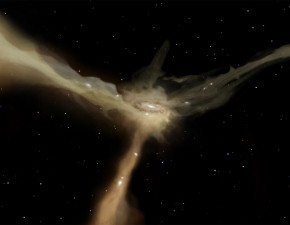 | 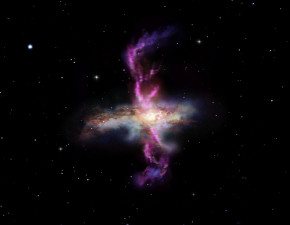 |
Left: Artist's impression of a galaxy forming stars in a gentle and steady fashion. Right: Artist's impression of an Ultra-Luminous InfraRed Galaxy (ULIRG) with outflows of molecular gas.
Credit: ESA/AOES Medialab | |
Another study based on Herschel data has assessed that these prolific galaxies can only form in the most massive haloes of dark matter – those with a mass as large as 300 billion times the mass of the Sun. Numerical simulations suggested to astronomers that galaxies take shape in the densest knots of the cosmic web – the wispy network of dark matter throughout the Universe. Herschel has allowed them to measure the mass threshold for the cradles where the most productive galaxies can form, which may be linked to the physical processes triggering the intense star-forming activity of these galaxies.
The change in star formation rates over time may also be linked to the supermassive black hole assumed to exist at the centre of most galaxies. In so-called active galaxies, the central black hole feeds on the surrounding matter at extraordinarily high rates. The radiation pressure created by this accretion triggers an outflow of material, which may drain the galaxy's reservoir of gas and quench its star formation.
"By monitoring a number of relatively nearby active galaxies with Herschel, we have detected, for the first time, vast amounts of outflowing gas that is molecular in nature," comments Albrecht Poglitsch from the Max-Planck-Institut für Extraterrestrische Physik, Germany, who is Principal Investigator of the Photodetector Array Camera and Spectrometer (PACS) on board Herschel. "This shows us that these outflows may indeed deplete a galaxy's supply to form stars, since it is from molecular gas that stars are made," he adds.
Astronomers have used Herschel's galaxy surveys, along with observations at other wavelengths, to search for a direct link between star formation and the activity of the central black hole in large samples of more distant galaxies. But these investigations have led to a variety of different results, indicating that more research will be needed to solve this particular puzzle.
Delving deep into the formation of stars and planetary systems in the Milky Way
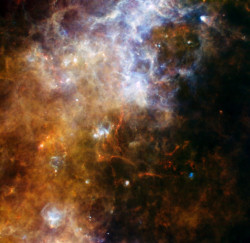 |
Dark cloud in the Southern Cross not so dark. Credit: ESA and the SPIRE & PACS consortium
|
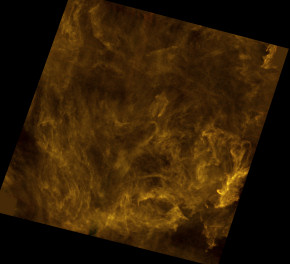
Observations closer to home, in our Galaxy, the Milky Way, yielded extraordinary revelations about the physical processes that give birth to stars. Herschel identified the presence of a filamentary network nearly everywhere in the interstellar medium that pervades the plane of our Galaxy, filaments which lead to the formation of stars.
"We did expect that there would be filaments in the interstellar medium, but Herschel finally gave us proof that they are omnipresent and that they are key to allowing star formation to occur," explains Matt Griffin. "Herschel's beautifully detailed images show how some clouds have developed filaments so dense that they are collapsing under their own weight and starting to form stars, while other clouds exhibit a more chaotic tangle of more tenuous filaments and are not dense enough to form stars – at least, not yet," he adds.
The emergence of filaments and their subsequent collapse into stars may also be linked to magnetic fields in interstellar clouds; Herschel's results have prompted further research into the role of magnetic fields in star formation, which can no longer be neglected.
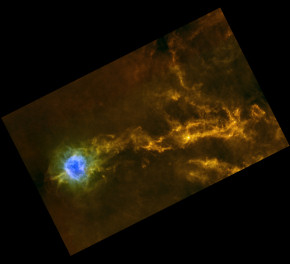 |  |
Left: The star-forming cloud IC 5146. Credit: ESA/Herschel/SPIRE/PACS/D. Arzoumanian (CEA Saclay) for the "Gould Belt survey" Key Programme Consortium.
Right: The Polaris Flare. Credit: ESA/Herschel/ SPIRE/Ph. André (CEA Saclay) for the "Gould Belt survey" Key Programme Consortium and A. Abergel (IAS Orsay) for the "Evolution of Interstellar Dust" Key Programme Consortium | |
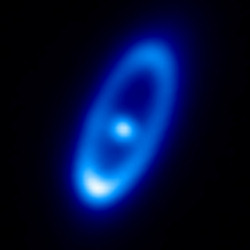 |
Herschel image of the star Fomalhaut and its debris disc.Credit:ESA/Herschel/PACS/ Bram Acke, KU Leuven, Belgium
|
Herschel has given a unique view of the subsequent stages in the formation of stars, and possibly of planetary systems around them. The image of a massive debris disc around nearby star Fomalhaut suggests a resemblance between this structure and the Kuiper belt as it may have appeared in the early days of our Solar System. The vast amount of dust in Fomalhaut's debris disc is produced by frequent collisions between comets within the disc. Herschel has detected more debris discs around other nearby stars, some of which host planets: a closer inspection of these data hints that debris discs may survive more easily in planetary systems without very massive planets like Jupiter.
"The study of extra-solar debris discs is providing us with new clues to the formation of planetary systems, and may eventually help us to achieve a more complete view of how our own Solar System formed and evolved from its parent cloud," says Albrecht Poglitsch.
Investigating the origin of water in planetary systems
Another highlight from Herschel is the study of the chemical composition of cosmic objects through high-resolution spectroscopy, and in particular the search for water in a variety of environments.
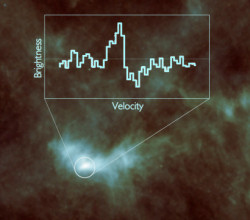 |
Water in L1544. Credit: ESA/Herschel/ SPIRE/HIFI/Caselli et al.
|
Studies based on Herschel data have indicated that a cold pre-stellar core in the vast Taurus molecular cloud hosts a reservoir of water ice amounting to a few million times the amount of water stored in Earth's oceans, and that the massive protoplanetary disc surrounding nearby star TW Hydrae contains a water vapour supply equivalent to several thousand times Earth's oceans.
"These results show that there is plenty of water available to enrich the surface of future planets, should they form in similar discs around stars other than the Sun," says Frank Helmich from SRON Netherlands Institute for Space Research, the Netherlands, who is the Principal Investigator of the Heterodyne Instrument for the Far Infrared (HIFI) on board Herschel.
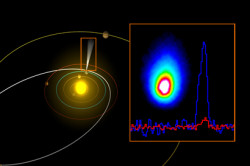 |
Herschel image and spectrum of comet 103P/Hartley 2 and its orbit.
Credit: ESA/AOES Medialab; Herschel/HssO Consortium |
Herschel has also contributed to the debate about the origin of water in the Solar System, and on Earth in particular. Astronomers believe that water was not present on the surface of our planet during its early days, but was brought here by comets and asteroids which stored water as ice. Asteroids were considered to be the primary source, but the case for comets strengthened after Herschel detected water in comet 103P/Hartley 2 with the same isotopic composition as Earth's oceans. Later observations of comet C/2009 P1 Garradd from Herschel found a different isotopic composition so the role of comets is still uncertain.
"The comparison between the composition of water in comets and on Earth's oceans may have far-reaching implications: if comets did contribute to enriching our planet with water, they might also be responsible for the delivery of other species, such as the carbon- and nitrogen-based compounds that are of great importance to the emergence of life," explains Helmich.
A peek at the future
Astronomers worldwide have so far used Herschel data to produce over 600 scientific papers published in refereed journals. But this is only the beginning: the careful analysis of Herschel's images and spectra will generate many more science discoveries and new insights for years to come.
"While the observations have ceased and the spacecraft will soon be propelled to a stable orbit around the Sun where it will remain indefinitely, Herschel as a science mission is by no means over," comments Pilbratt. "Most of Herschel's data are publicly available already. We will continue supporting the community exploiting the data, collecting and producing the best possible data products in the form of maps, spectra, and various catalogues to benefit all astronomers working with Herschel. We are looking forward to the multitude of great discoveries that are still ahead of us."
Notes for editors
Herschel is an ESA space observatory sensitive to far-infrared and sub-millimetre wavelengths, with science instruments provided by European-led Principal Investigator consortia and with important participation from NASA. Launched on 14 May 2009, Herschel is equipped with a primary mirror 3.5 m across, making it the largest, most powerful infrared telescope ever flown in space.
Its payload consists of three instruments: the Photodetector Array Camera and Spectrometer (PACS), the Spectral and Photometric Imaging Receiver (SPIRE), and the Heterodyne Instrument for the Far Infrared (HIFI). All three instruments were cooled to -271°C inside a cryostat filled with 2300 litres of liquid superfluid helium, which weighed 335 kg – nearly 10 percent of Herschel's mass at launch. After almost four years of observations, the mission finally exhausted its coolant today.
Herschel has executed over 35 000 scientific observations, amassing more than 25 000 hours worth of science data from about 600 observing programmes. A further 2000 hours of calibration observations also contribute to the rich dataset.
Herschel will continue communicating with its ground stations for a few weeks after the helium is exhausted, during which a range of technical tests will be performed. Finally, in May, it will be propelled into its long-term stable orbit around the Sun, where it will remain indefinitely, and safe from Earth impact for several hundreds of years.
The PACS instrument contains an imaging photometer (camera) and an imaging spectrometer. The camera operates in three bands centred on 70, 100, and 160 μm, respectively, and the spectrometer covers the wavelength range between 51 and 220 μm. PACS has been developed by a consortium of institutes led by MPE (Germany) and including UVIE (Austria); KU Leuven, CSL, IMEC (Belgium); CEA, LAM (France); MPIA (Germany); INAF-IFSI/OAA/OAP/OAT, LENS, SISSA (Italy); IAC (Spain). This development has been supported by the funding agencies BMVIT (Austria), ESA-PRODEX (Belgium), CEA/CNES (France), DLR (Germany), ASI/INAF (Italy), and CICYT/MCYT (Spain).
The SPIRE instrument contains an imaging photometer (camera) and an imaging spectrometer. The camera operates in three wavelength bands centred on 250, 350 and 500 µm, and so can make images of the sky simultaneously in three sub-millimetre colours; the spectrometer covers the wavelength range between 194 and 671 μm. SPIRE has been developed by a consortium of institutes led by Cardiff Univ. (UK) and including Univ. Lethbridge (Canada); NAOC (China); CEA, LAM (France); IFSI, Univ. Padua (Italy); IAC (Spain); Stockholm Observatory (Sweden); Imperial College London, RAL, UCL-MSSL, UKATC, Univ. Sussex (UK); Caltech, JPL, NHSC, Univ. Colorado (USA). This development has been supported by national funding agencies: CSA (Canada); NAOC (China); CEA, CNES, CNRS (France); ASI (Italy); MCINN (Spain); SNSB (Sweden); STFC and UKSA (UK); and NASA (USA).
The HIFI instrument is a very high-resolution heterodyne spectrometer and operates in seven bands covering the wavelength range between 157 and 625 µm. HIFI has been designed and built by a consortium of institutes and university departments across Europe, Canada, and the United States under the leadership of SRON Netherlands Institute for Space Research, the Netherlands, with major contributions from Germany, France, and the US. HIFI Consortium members are: CSA, U. Waterloo (Canada); CESR, LAB, LERMA, IRAM (France); KOSMA, MPIfR, MPS (Germany); NUI Maynooth (Ireland); ASI, IFSI-INAF, Osservatorio Astrofisico di Arcetri-INAF (Italy); SRON, TUD (Netherlands); CAMK, CBK (Poland); Observatorio Astronómico Nacional (IGN), Centro de Astrobiología (CSIC-INTA) (Spain); Chalmers University of Technology - MC2, RSS & GARD, Onsala Space Observatory, Swedish National Space Board, Stockholm University - Stockholm Observatory (Sweden); ETH Zurich, FHNW (Switzerland); Caltech, JPL, NHSC (USA).
CONTACTS
Thomas Passvogel
Herschel and Planck Programme Manager
ESA, The Netherlands
Email: Thomas.Passvogel esa.int
Phone: +31-71-5655962
Herschel and Planck Programme Manager
ESA, The Netherlands
Email: Thomas.Passvogel
esa.intPhone: +31-71-5655962
Göran Pilbratt
Herschel Project Scientist
Research and Scientific Support Department
Science and Robotic Exploration Directorate
ESA, The Netherlands
Email: gpilbrattrssd.esa.int
Phone: +31-71-5653621
Herschel Project Scientist
Research and Scientific Support Department
Science and Robotic Exploration Directorate
ESA, The Netherlands
Email: gpilbratt
rssd.esa.intPhone: +31-71-5653621
Matt Griffin
Principal Investigator of SPIRE
School of Physics and Astronomy
Cardiff University, UK
Email: Matt.Griffinastro.cf.ac.uk
Phone: +44-29-208-74203
Principal Investigator of SPIRE
School of Physics and Astronomy
Cardiff University, UK
Email: Matt.Griffin
astro.cf.ac.ukPhone: +44-29-208-74203
Albrecht Poglitsch
Principal Investigator of PACS
Max-Planck-Institut für extraterrestrische Physik (MPE)
Garching, Germany
Email: alpogmpe.mpg.de
Phone: +49-89-30000-3293
Principal Investigator of PACS
Max-Planck-Institut für extraterrestrische Physik (MPE)
Garching, Germany
Email: alpog
mpe.mpg.dePhone: +49-89-30000-3293
Frank Helmich
Principal Investigator for HIFI
SRON Netherlands Institute for Space Research
Groningen, The Netherlands
Email: F.P.Helmichsron.nl
Phone: +31-50-363-4799
Principal Investigator for HIFI
SRON Netherlands Institute for Space Research
Groningen, The Netherlands
Email: F.P.Helmich
sron.nlPhone: +31-50-363-4799
Last Update: 29 Apr 2013
Source: ESA -
SCIENCE AND TECHNOLOGY , HERSCHEL


